Monday, 21 March 2016

After "Barbaric Vast & Wild": A Symposium & Poetry Festival


CfP

Outside-in / Inside-out

A Symposium / Poetry Festival on Outside and Subterranean Poetry
                                                                                                                                                                                       University of Glasgow, Centre for Contemporary Arts and Glasgow
Women�s Library: 5-7 October 2016
C:\Users\Owner\AppData\Local\Temp\Q2ao7sApVn\index.html

CALL FOR PAPERS
Inspired by the recently published fifth volume of Poems for the Millennium, Barbaric Vast & Wild: A Gathering of Outside & Subterranean Poetry from Origins to Present, this symposium will open up views to poetry past, present, and potentially future with the question: Is there something in poetry �outside� (economically, racially, nationally, formally, etc.) and �subterranean� (suppressed by political and poetic hegemonies) that may lie at the heart of the most vital poetic practice? In their new groundbreaking gathering, Jerome Rothenberg and John Bloomberg-Rissman have assembled a wide range of poems and related language works, in which outside/outsider and subterranean/subversive positions challenge the boundaries of poetry. Poetic form and substance may be rethought from these new perspectives as fundamental and generative; as the editors write: �conditions of outsideness may create � a field for the invention of new or special forms and modes of language.�
Outside-in / Inside-out will address the disparate realms of poetry created by, or emerging from, the condition of being outside dominant and official positions. Like Barbaric Vast & Wild, we encourage presentations on moments in the history of outside/subterranean poetry; yet ultimately we will pitch these findings towards contemporary poetry practices. For us, the terms �outside� and �subterranean� must include ideas not only discussed among successful poets and academics solely within a university setting; therefore the symposium will be held in venues with varying access to public audiences and participants, including the University of Glasgow, the Glasgow Centre for Contemporary Arts (CCA), and the Glasgow Women�s Library.  In our symposium, �outside� and �subterranean� also imply modes of formal presentation that may subvert the typical conference format.  If the participant wishes, he or she may replace or modify so-called critical/scholarly work with so-called �creative� or performance work, and vice versa.  In order to generate many approaches to the framework of outsideness, the three-day symposium will include a mix of panel presentations, roundtable discussions, workshops, and (two evenings at the CCA) readings and performances.

We are fortunate to be able to supplement these events with three exhibitions:
1) the history of Concrete poetry as an outside art through the archives of Bob Cobbing and Hansj�rg Mayer  2) the Concrete poetry of two Scottish poets, Ian Hamilton Finlay and Edwin Morgan  and 3) �The Homeless Library�, a poetry and art collaboration by homeless people in Manchester.

An exciting line-up of poets, researchers, and curators have already confirmed attendance, including among others Charles Bernstein, Sean Bonney, Andrea Brady, Julie Carr, Phillip Davenport, Gerrie Fellows, Bronac Ferran, Alec Finlay, Sara Guyer, Pierre Joris, Tom Leonard, Gerry Loose, Aonghas MacNeacail, Peter Manson, Maggie O�Sullivan, Sandeep Parmar, Holly Pester, Nicole Peyrafitte, and Jerome Rothenberg.
 The conference organisers invite proposals for ten to twenty-minute creative and/or scholarly papers and performances. Possible topics for presentations include, but are not limited to:
Problems of defining �outside� in poetry and poetics:

What is �outside�? What is �inside�? Can one become the
other?                                                                                                                                                                                    How do �outside� and �subterranean� differ from each
other?                                                                                                                                                                                               Are �outside� and �subterranean� useful terms for
exploring poetics?                                                                                                                                                                       What are the values and risks involved in recuperating
�outside� poetry?                                                       
Sociological and historical analyses of styles and movements of �outside� poetry, or poetry produced from cultural, political and economic marginalization.
Historical instances of �outside� poetry and poetics:

 A tradition of the outside or subterranean poets: e.g. William Langland, William Blake, John Clare:
  • 18-19th Century women�s poetry
  • Pre-20th Century working class poetry
  • The relationship of �outside� or �subterranean� poetry to movements such as Romanticism and Modernism
  • Barbaric Vast & Wild and the politics of anthologies

The relationship between �outside� poetry and formal experiment and/or experimental art, e.g. Concrete poetry, Text Art, New Media poetries.
 Readings of non-poetic material and ephemera as poetry.

 The role of archives and distribution in the formation of �outside� and �subterranean� poetry.
 Formally and politically subversive gestures of �outside� poetry and poetics: e.g. �nomad� poetics.

 Poetry which may be considered �outside� or �subterranean� such as:
 �      Art brut

�      Women�s work
�      Popular and newspaper poetry

�      Works responding to conditions of deliberate, self-imposed exile
�      Works created out of/responding to outsider-ness due to physical and mental circumstances, disability, race, sexuality, homelessness, economics, class, gender, political stance, etc.
�      Works which dispense with genre boundaries or operate meaningfully across them

�      Works in dialects and �nation languages�
�      Ancient prophetic writing

�      Song forms such as ballads, rap, pop
Please send an abstract of up to 300 words by 15th April 2016 to: outside poetry [at] gmail [dot] com. We will endeavour to respond by 31st May 2016.

 The organisers of Outside-in / Inside-out are:
 Dr Colin Herd, University of Glasgow

Dr Lila Matsumoto, University of Edinburgh
nick-e melville, University of Glasgow

Professor Jeffrey Robinson, University of Glasgow
Dr Calum Rodger, University of Glasgow

Dr Nuala Watt, University of Glasgow
https://outsidepoetryfestival.wordpress.com

Tuesday, 8 March 2016

Jeffrey Angles: A Translator�s note on the 2010 Kumamoto Renshi (Linked Poetry) Session


Sunday 15 August 2010
Toward a new appreciation of the collaborative

During the romantic era, the notion that individuality represented the source of all new developments in the art world came to have enormous cultural influence in the West. Rather than seeing poets, writers, visual artists, composers and performers as temporally bound people working within (and often against) the bounds of their own cultures and prison-houses of language to produce their work, the romantic era tended to view artists as visionaries who dove into the depths of their individuality to present new, personal works that spoke of their vision of the world. It is no wonder then that the figure of the genius � a person who was seen as possessing an distinctive personality and mind that presented them with idiosyncratic visions different from those of everyone else�s � grew to figure so prominently in romantic concepts of art, music and literature.

Even now, in the early twenty-first century, the romantic notion of art, with its ideas of singular authorship and vision, continues to have a great pull over our contemporary imaginations. Perhaps nowhere is this more apparent than in the acclaim given to individual producers of so-called �high culture�. It is common to praise people as great authors, artists and poets � even geniuses � while forgetting that what we call �greatness� is not just the result of natural skill and vision, but also hard work, learning, practice and honed craftsmanship. The flip side of this respect for the individual artist is that our society tends to place less value on artistic products born out of cooperative acts of creation. For instance, commercial publishers tend to shy away from co-authored books, and academia, at least in the United States, tends to place less weight upon co-authored books or (even worse) translations. In the visual art market, people assume, a piece of art is less interesting and valuable if it is not the sole product of a single individual. It is precisely for this reason that agents behind many commercially successfully visual artists who do rely on helpers tend to gloss over this fact in marketing. (For instance, it is common to see exhibitions of Dale Chihuly, Jeff Koons or Takashi Murakami which do not even mention the fact that each of these artists hands off their ideas to crews of loyal workers who execute them.)

Still, when one stops to think, what pieces of art are not collaborative in nature? Architecture requires not just an architect, but engineers and labourers to produce. Cinema involves not just a director and actors, but often casts of hundreds, if not thousands of others. Music involves a collaborative effort between composer and performers, even though sometimes they might live hundreds of years apart. Artists often rely upon advice and help of technicians, friends, or fellow artists, and even when they do not, it is still the gallery or museum curator who determines the ways an artistic work is seen and the value bestowed upon it. Writing usually involves intimate collaborations with editors. Not only do they do much of the final shaping of contents; in the end, editors are the ones who determine what exactly will be seen by the world. In addition, postmodern theory has, at least in the academy, started to change the ways people see the relationship between the individualism and art. Focusing on the flow of ideas and power relationships that structure a work, poststructuralism emphasises those aspects of creative acts that are beyond the control of the individual creator. If anything, the creator is only one focus within a network of historical and linguistic forces � one operation within the parameters of complex semiotic systems that predate the artist him- or herself.

If art is necessarily collaborative, then perhaps it is incumbent upon us to shift radically the ways that we think about ownership in the linguistic and visual arts. Perhaps it would make sense for us, as readers and consumers of culture, to celebrate collaboration between poets, novelists, translators, visual artists, musicians and performers. Perhaps it would make sense for us to seek out genres of artistic production that highlight and celebrate collaboration, not just because they present us with exciting, fresh flows of ideas, but also because they do the important work of unsettling traditional, conservative notions of intellectual proprietorship and truth.

Renshi as collaborative poetry 

The argument above is a roundabout way of arguing for the value of collaborative poetic endeavours. Poetry has been a field that has been especially prone to the romantic cult of individuality, no doubt in large part due to the ideal that the poet represents a sort of �seer�. (In fact, this idea of poet-as-seer has roots at least as far back as Greek thought, but certainly, it took on new force in the romantic era.) Nonetheless, we should not allow this to eclipse our appreciation for other kinds of poetry that has been created through interesting and innovative forms of collaboration, especially considering how important such collaborations has been in the history of poetry around the world.

One of the most exciting, dynamic forms of contemporary collaborative poetic production today is renshi or �linked poetry� � the modern offshoot of a far older verse form known as renga (�linked songs�), which was popular in medieval and early modern Japan. In renga, poets would cooperate to write poems with fixed metrical patterns of 5-7 and 5-7-7 sound units. One poet would compose a handful of lines in these metres, then the next would pick up on themes in that opening verse to comprise another segment, and so on. In each turn, the poet would move in a slightly different direction. Although it would still honour the spirit of the earlier verse by drawing upon some theme or image in it, it would have its own unique focus or message. In his study of renga, the Japanese literary scholar Earl Miner wrote that in renga �no stanza has a continuing semantic connection, as a discrete poetic unit, with anything other than its predecessor and successor. We can choose if we like to consider it in itself. We must consider each as a fresh view of its predecessor, which it completes. And we must consider it also as the basis of the next stanza, which alters it in making a new poetic unit. It has no such connection beyond.�(1) With each verse building upon the previous one, the sequence continues until reaching a predetermined number. Still, the poets were not entirely free to do whatever they liked at each turn. Within renga, there was a series of complex rules that governed when and how different thematic elements were introduced, for example, images of the moon, the seasons, or other elements of nature.

In 1969, the Mexican poet Octavio Paz, then living in Paris, brought together a group of four poets to compose a series of linked verses based loosely on the rules of traditional Japanese verse. His partners were Jacques Roubaud from France, Edoardo Sanguineti from Italy, and Charles Tomlinson from Britain. After a fun and intense week of writing, the results were translated into all of the languages of the participants. In a nod to the metrical traditions of Japanese renga, the participants wrote their work in fragments that would, when pieced together, form a series of sonnets. This innovative way of collaborating caused a small stir in the poetic world of the time, suggesting the exciting possibilities for a new kind of poetic production. Soon afterward, these poems were translated into Japanese and, ironically, helped give birth to a new style of poetry in Japancalled renshi.

The character shi of the word renshi often refers more specifically to the kind of poetry that developed in the late nineteenth and twentieth centuries and that did not necessarily adhere to traditional strictures on length, rhythm, and diction. In other words, renshi differs from renga in that it is written in shi, which are relatively flexible in terms of content and poetic rules. Participants in a renshi session typically agree beforehand on the total number of verses and the number of lines each person will contribute per round. Each contribution should play off, but not adhere too closely to, the one that came before it. In other words, there should be a cognitive leap between each verse, but the verse should not be so far that it is completely unrelated. As a result, the renshi grows organically, moving in new directions, treating new subjects, and resisting attempts to pin it down too closely to one ideology or theme.

One might think of renshi perhaps as being somewhat akin to a jazz improvisation. Several players appear on stage at once, gathered for a single purpose, but the players take turns performing their solos on different instruments � usually, in the case of renshi, different types and styles of poetic writing. The first �performer� might present his work using one instrument � verses written in a terse, avant-garde style perhaps � then steps into the background to let the next �performer� step forward and take the stage. Within the first riff are the themes to which the second �performer� creates her improvisation, which she performs using a slightly different style � perhaps verses with a more narrative quality. In a sense, the first �performer� is not entirely silent through the second verse; by providing the themes for the second verse, it is almost as if he is performing the accompaniment in the background. Where renshi differs from jazz improvisations is that jazz typically involves a return to certain pre-agreed-upon key signatures and melodies, culminating in a sense of recognition and excitement when those musical elements come round again. Renshi, however, continually moves outward, treating new ideas and themes, not necessarily returning to a single point of return unless the poets desire to bring it home in such a way. In a sense, the kind of collaboration that takes place in renshi is always making new forays into the unknown.

Because renshi shifts from voice to voice � �instrument� to �instrument� in the analogy above � renshi may seem avant-garde and perhaps even perplexing to readers who are used to poetry written with a single overarching message or voice. Readingrenshi requires a mindset different than reading poetry penned by a single person. Like older forms of Japanese linked verse, renshi do not have integral �plots� that run throughout the entire work. They are �linked in a continuity at each point of juncture but are otherwise discontinuous in plot�.(3)  Just as the authorship shifts from person to person at the point of juncture between poems, so the authorial voice can shift, thus changing perspective radically. Rather than considering the work overall as a single, unified work that represents the product of a single artistic drive, the reader should take each nugget of verse � each little jazz-like riff � as its own little world. Each is separate and could be considered on its own, but it is more interesting when seen in relation to what comes before and after it, rather in the way that clusters of stars are more interesting when one sees them as constellations. Renshi are not what Roland Barthes would have called �readerly texts� � ones that provide all the information necessary for readers to consume them in a passive, unthinking way; instead, renshi are �writerly texts� � writing with gaps and suggestive pauses that invite the reader to become involved by making their own sense out of the work. In this sense, renshi do not just involve creative collaboration between poets, but also between the text and reader.

In the decades since Paz organised his now famous series of linked verses, the Japanese poet Makoto Ooka has served as a major champion of renshi. He and the poets associated with his poetry magazine Oar (Kai) have organised many renshi sessions with poets from Japanand around the world, many of which have been published in book form in Japanese and other languages.(4) In recent years, the prominent poet Shuntaro Tanikawa has taken up the lead in promoting renshi in Japan. Participating and organising renshi events through the country, Tanikawa has used his enormous popularity to foster new interest in the possibilities of decentered, collaborative verse. Meanwhile, internet and wiki technology have made it easy for poets to collaborate even when they are far apart. As a result of all of these factors, there is more interest than ever in the production of renshi in Japan.

�Connecting through the Voice�: The Kumamoto renshi 

In March 2010, four prominent Japanese poets, Shuntaro Tanikawa, Hiromi Ito, Yasuhiro Yotsumoto and Wakako Kaku, plus the well-known American poet Jerome Rothenberg, met in the southern Japanese castle-town of Kumamoto for three days of writing renshi. The poets had gathered together from their homes in three nations � Japan, America, and Germany � and because they were writing in both Japanese and English, I also joined them as a translator to help render the poems and facilitate communication.(5) As the sabakite or �judge� who would organise the progress of the renshi, Shuntaro Tanikawa set the rule that each poet could write up to ten lines per round, and he developed a system of rotation so that each poet would not follow any other poet more than twice during the course of the sequence.

Because all were eager to embark upon this project, the poets began exchanging verses via e-mail even before meeting. As a result, many of the earliest verses in the sequence are full of excited optimism about the prospect of coming to Kumamoto to write. Hiromi Ito started off the sequence with a four-line quotation from a local, sacred song preserved in the annual festival at the nearby Aso Shrine. These lines describe the singers� eagerness to put their voices together in song � a fine introduction to a series of verses written by poets coming together from around the world. Shuntaro Tanikawa followed with a celebratory verse containing pastoral images children playing as visitor�s words flourish nearby. Jerome Rothenberg�s verse picked up on an image in Tanikawa�s verse of an underground world associated with the dead and linked it to the idea of sheol, the Jewish underworld.

Wakako Kaku�s verse, narrated from the point of view of one of the great primeval goddesses of the Kojiki (Record of Ancient Matters), continues the tone of welcome of the previous poems, but rather than an individual welcoming others, her narrator is a goddess whose body is a volcano, and she welcomes the destructive lava that flows through her. (Kumamotois located nearby Mount Aso, an active volcano that still spews rocks and poison gas on a daily basis.) Leading on from this, Yasuhiro Yotsumoto took the image of flowing red and shifted perspective radically, writing about a woman who, fearing she was pregnant, welcomes the menstruation that she feels beginning as she watches a diorama of an erupting volcano in the Mount Aso museum. In this way, themes and images passed from poet to poet in the first round of poems as each one stepped out on stage, performed their own improvisational riff, and then stepped back again into the background to accompany the next person as they took the lead in directing the progress of the improvisation. By the time these five verses had been completed, the series of poems had arrived at a place that most likely none of the individual poets could have predicted at the outset.

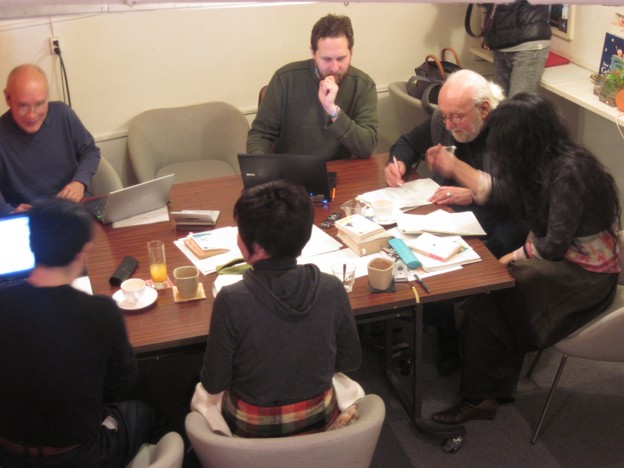
Except for the first few verses, which were done by e-mail, most of the work was conducted in intense bursts of writing while sitting together in a coffee shop named Orange in Kumamoto. The process involved a great deal of consultation as we discussed the finer points of the poems, debated whether or not one verse was too close to another that followed, and considered potential translations for certain phrases. (On these matters, the sabakite, Shuntaro Tanikawa, had the final say.) Much like the renga sessions of old, which often involved bursts of creative output between delicious food, sak� and baths in hot springs, we punctuated our writing with meals together, excursions to local sites and drinks in the evening. The result was an intense spirit of camaraderie and cooperation, especially as the days wore on and we had to begin working at an increasingly frenetic pace to finish the thirty verses we had agreed upon in advance.

Of the various approaches to writing, Ito�s was perhaps the most striking. Rather than penning her own original words for this project, all of her verses consisted of quotations, which she selected with deliberation and care. Her goal, she explained, was to try to find ways to use the voice of others to present her own � an intertextual move that introduced an additional element of collaboration within the renshi. In a brilliant metapoetic moment at the beginning of verse number 27, Yotsumoto humorously comments on Ito�s use of quotations, noting that although she relied upon quotations through to the very end, Ito had revealed her own individual personality through them, much as a shape-shifting tanuki accidentally reveals its tail.

After completing thirty verses, on 10 March, we gathered for a public reading of the poems in front of a packed auditorium. All of the seats had been sold out for over a mouth, the audience drawn by the impressive constellation of famous poets that had come to cooperate in the project. The spectators were rapt as we read our work and discussed the links between verses. One highlight of the performance came at the end of the presentation. In verse 13, Tanikawa had described a young actress who, after playing the role of a mute on stage, goes home singing. In verse 14, Yotsumoto had written the lyrics of the song he imagined her to be singing. Kaku is an accomplished musician and composer, and when she was not busy writing her own verses for the renshi, she volunteered to compose a song to accompany the lyrics. At the end of the reading, Kaku and Yotsumoto performed the song, she with her guitar and him singing for all he was worth. It was a rousing moment, and not surprisingly, the audience went wild, cheering for the great collaborative gift these poets had given them. Three cheers for renshi!


[N.B. Originally published in Poetry International Rotterdam 2010.  See also Jerome Rothenberg�s account, �A Round of Renshi� posted in three installments (2012) on Poems and Poetics.]

Thursday, 3 March 2016

Books & Readings in Paris, with a Short Essay on the French Connection


This posting will find me in Paris, where a series of readings has been scheduled in celebration of three books newly translated into French:

Secouer la Citrouille (Shaking the Pumpkin), translation by Anne Talvaz, Presses Universitaires de Rouen et du Havre

Journal Seneca (A Seneca Journal), translation by Didier Pemerle, Editions Jose Corti

Un Champ sur Mars (A Field on Mars), translation by Anne-Laure Tissut, Presses Universitaires de Rouen et du Havre, with a separate edition in English

The planned readings include the following:

Reading & launch, Mus�e de Quai Branly, Paris, Salon de Lecture J. Kerchache, 4:00 p.m., March 6.

Reading, Poets Live, at Berkeley Books, 8, rue Casimir Delavigne, Paris 75006, 7:30 p.m., March 8.

Reading, Librairie les Oiseaux Rares, 1 rue Vulpian, Paris75013, m�tro Corvisart, 7:30 p.m., March 12

Readings & talk in a conference on �Responsabilit�s de la Po�sie" at Universit� de Rouen et du Havre, 10:15 a.m. & 3:00 p.m., March 14.

Reading, Librairie la Lucarne des Ecrivains, 115 rue de l�Ourcq, Paris 75019, 7:30 p.m., March 15.

An important corollary to all this is the strong connection that many of us have felt between what we used to call �the new American poetry� & modernist traditions in France & elsewhere going back to the sources of experimental modernism & postmodernism in the century before this.  In connection with this I was commissioned in 2002 to write a short essay on �the French connection� for Kader el-Janabi�s short-lived magazine Arapoetica, then being published in Paris.  While the essay was never published before the magazine�s demise, I�m including it below, as an indication of the international/intercultural view of poetry & poetics that I�ve tried to promote both then & now, there & here. (J.R.)

For Kader El-Janabi: The French Connection
into my own dark sunday light approaches like the moon through feathers that�s no sooner seen than sunk by blindness & the thought that everyone is dead around a city that�s about to vanish as it has before sucked down an empty pocket oversized & with a smell of earth the bright adventurers of 1910 whose streets these were sharing a common grave with those who followed reaching even to the place where you and I are waiting with the friends who drop out one by one like cybermonkeys flying into mindless space

dans mon sombre dimanche � moi la lumi�re s�approche comme la lune � travers des plumes ce qui � peine vue sombre coul�e par l�aveuglement & la pens�e que tout le monde est mort autour d�une ville sur le point de dispara�tre tout comme elle l�a fait auparavant engloutie dans une poche vide et d�mesur�e & avec  une odeur de terre les lumineux aventuriers de 1910 dont c��taient les rues partageaient une tombe commune avec ceux qui ont suivi atteignant m�me l�endroit o� toi et moi attendons en compagnie des amis partis un � un comme des cybersinges s�envolant dans l�espace insouciant
     � the opening of �Trois �l�gies Parisiennes� (Three Paris Elegies)
      translated into French by Jean Portante]

For myself, writing and living in late-twentieth-century America, there was a sense that all of us, as poets, shared a past and future with forerunners and contemporaries across a startling range of times and places.  This came at a time when we were discovering ourselves also as American poets with a new language in which to write and a new perspective � a series of new perspectives � that we could write from.  If the thrill of the moment led some into an easy jingoism or a more interesting localism, for others it opened the possibility of an experience of poetry and life that could truly push against the boundaries of languages and cultures. 
            For those of us who meant to proceed by new means, modern means � to be �absolutely modern� in Rimbaud�s phrase � the memory and presence of Paris and France loomed large.  Never mind that at the same time we were discovering Americaor that we were determined dwellers in our own cities (New York, San Francisco, Los Angeles, Chicago).  Parisas city and vortex (Pound�s word) was with us in our imagination as poets � even for those of us who had never set foot there.  There were exceptions of course � poets who felt themselves to be more exclusively American or were themselves distanced from the great cities of America and Europe; Snyder and Olson, say, among the really good ones.  But for myself again, Paris, once I had found it, was a place I could inhabit, not the physical city so much as the world of experimental and radical modernism that the city had once come to represent.  Post-modernism, for myself and my companions, was no more than the transfer � often contentious � of the older modernist impulse into a new terrain and time.
            I have lived almost my whole life on the two coasts of North America � New York first and California later.  From both of these Europewas less than a single day�s travel, and because that travel became increasingly possible (starting for me in the late 1960s), I came to think of myself as inhabiting two continents.  In 1997 I spent four months in Paris, and there have been several other extended visits since then.  At the time of the 1997 trip I had initiated, with Pierre Joris, a translation project that would extend over the next few years and would form a part as well of the Poems for the Millennium series that we had inaugurated a year or two earlier.  What we had chosen to do was to translate the collected poetry of Picasso into English, Pierre to focus on the French and I on the Spanish.  So I brought Picasso with me to Paris, or in another sense, I found him there: Picasso and other ghosts in a Paris that had long since dissolved into history and myth, leaving their names on houses and streets or, for some, etched onto tombstones in the city�s great cemeteries.
            I began in fact to think of Paris as a cemetery city, a city filled with ghosts � both its ghosts and ours.  The presence of the dead was then particularly strong for me, because of a number of friends who had died over the preceding year.  These mingled with the ghosts of that early avant-garde whose place had been here and whose work we had been determined � some of us � to reach and to surpass.  But more than that of course, there was the actual city as it existed in the summer and autumn of 1997 � an evidently threatened economy that made for an increased number of beggars, some curiously well-dressed I thought, in the streets where we were living.  That was in a space between La R�publique and the Canal, where in the square itself one afternoon we saw what seemed to be a large soup kitchen for the unemployed.  And whatever I saw there fused quite naturally with Picasso�s words as we had brought them over into English: 

                         the blockhead who stretching out his hand 
                         asks them for a little alms sitting alone on 
                         the ground in the middle of the plaza
and again:
over the beggar�s hand
only adorned with blossoms
alms collected through those worlds
he pulls along

All this to form another continuity.
            The poem �Three Paris Elegies,� translated in its entirety by Jean Portante, is not only a lament for the dead and the living, but a celebration of my own French connection as it appeared to me in 1997.  The first of the elegies, quoted above, is derived from Picasso�s favored form, a block of prose absent all punctuation, and the second, not shown here, is the account of an event, a minor existential crisis, in the Pyrenees.  It is in the third, however, that the fusion takes place � of past and present, dream and waking life � and leads me to the realization of a world in which time loses its meaning in a simultaneous present which isn�t time at all.  If this can travel from my own place and language into yours, Kader, then it�s likely that another connection will have taken place.

Jerome Rothenberg
Paris/Encinitas

November 2002

Saturday, 27 February 2016

George Quasha: from Alternate Lingualities (preverbs), with a note on �Self-Organized Criticality�

George Quasha's 'axial art,' from the artist's website
(Six from a series of thirty-four poems)
                                                                            for Lissa Wolsak

1                                    taller tales still to untell

My life or this dream may have matured to the point where I 
     can say I eat earth.
Suddenly I see myself dancing alone never alone in a mirror 

     reflectively still.
I woke in a sweat because I remembered I have no name.
Mind awakens by field, fireflies.
Eating earth is not eating dirt, the latter requiring more 

     complex evolution.
We�re only foreplaying in the sensible.
Dragon eyes are her apertures and my port of entry.
No customs pertain.
Finding fire in the cold of her body I lit up.
Anima animates my animal awake to her human.
Reading certain texts you touch a mind you could never find.
I can say what is true so long as I do not believe it.
I�m still tracking the beings I know without knowing�
     especially not who.
The faith of the bowman is beyond belief.
The tall slender high-heeled tale goes like this dakini 

     sounding of unknown origin. 
The target sucks in the arrow.
Effortless expression has got my number.
Vida: Eat pussy with fire until turning up swirl rouses 

     the dragon.
No need to believe that�there�s no her and no me where 
     she has us going.

2                                  spread

I�m revising my sense of beauty as we speak.
I write the line as if running out of ink.
It means the book means in flashes of the field, surrounded 

     and self-erasing.
In the end nothing to rely on but a hunch.
The ego doesn�t die, it just fragments, pales, and multiplies.
It�s got craft if attachment releases without rejection of 
     sensual texture.
You see it in deep cloud activity with your own eyes, not 

     entirely yours.
My life or this dream may have matured to the point where 

     I can say I drink dragons.
Running out of ink running out of my cave, all for love of 
     cageless eggs and spread.
Order is performative.
It hits the spot.
The cloud is making offerings on my behalf which helps 
     me across the bridge.
I can only say this due to the proto-allegorical tendencies 

     of my life in footnotes.
Distraction is not knowing the speaking is going on 

     without your apparent consent.
Duly noted and on foot as reflected by the page.
I get lost enough to let it show.
Notably: The greatest number of egos congregate where 

     one has been annihilated.
This line of thinking accounts for my no count identity.
I grow less sure of one as a day ages.


20                           gender dynamic

Poetry is language willing to get excited not knowing what 
     it is.
In the divine moment the mirror looks the other way.
Only the things never thought can reach us at this distance.
Fixtures of body are depressions of form.
Mirror art is less and less reliable, only where spooked it 

     reflects further.
The poem keeps turning away from itself to escape conditions.
Pronouns are drifting, feeling unwanted.
When I see myself clearly I�m the echo of my poems.
Contradictions come to light like moths.
Disappearing shadows guide my reading.
Body patterns depress.
Known beauty is parasitic.
Buddhas teach nothing.
It�s tomorrow all around the poem where I hides from 
     aggression.
There�s discursive hope in confusing pronouns.
You answer my burning question and I cool down inside.
She answers, I heat, the attitude producing the question ignites.
Mystical union gives off interpronominal pulsation.


22                           story is a killer
       
Chi riding wind scatters till meeting water retains.
I write what I long to read that longs to be read and it lengthens,
      then cut.
No blow benign unless driven by winds of unaccountable 
     awareness.
I take back all strikes against others and myself but note not all 
     rush back home.
The same for the opposite but there is no opposite. It�s narration, 

     how we get here.
The sky clouds, the line crowds: step by stop, word by world, 
     repeat not, no spell.
Refuge narrates unless the breath draws up unaccountable 

     awareness.
The book is watching. The page flicks askance. Rhetorical fractals. 
     Deadly story.
Literary mind is never ready for its ditch.
Fencing distracts from vulnerability.
In an instant I am my poem.
What was I thinking before the train blew through� but the 

     thought escapes me.
All the poems ever read are your own forever but who�s counting�
Your life work talking about itself talking about itself tracks itself 
     when you let it.
It�s a diary of everything that never happened before its moment.
Instantly speaking its dialect of not ever before loses me but now 

     I�m found, telling.
Follow the appetites.
A surface moving aright feels the surgent underpulse of verb 

     acting up in flow.
Lingual eros tells the touch that takes itself back at the threshold.


23                           body at large
      
The frog pond knows you�re listening.
The poem gets excited being read.
No one can prove any of this which qualifies it to be the subject 

     of poetry.
Music spirals in the head, in the cells, in the room.
This is what we mean by touching.
You get what you can handle.                                 
Listening to the same sound equals breathing the same air.
Getting so close you wonder how can anything contaminate 

     the unlimited.
Listeners touch from inside to inside direct.
Self-celebratory mind is never ready for potholes.
When failure to find order times out the session reading mind 

     crashes.
If only it had held on longer it could have bottomed out and 

     burned with the poem.
The true subject of poetry is knitting, scale-invariant.
Concerto robust weave around chamber sensitive skin.
I keep hoping I�ll find the fit but it finds me first.
The theme fields are barely edible.
That had to be written lest she refuse me unaccountable 
     awareness.
If I�ve said it once I�ve overspoken for a self-true body of work 

     teaches itself.
Suddenly I�m watching squirrels with my whole body leaping 
     through trees to tips.


25                          seeing from behind

Language has better things to do than say what I mean.
Picking on pronouns may be a cheap trick vitalized by an 

     unfolding nature of things.
We hold their feet to the fire and suffer the burn.
Successful communication is blood from a turnip-shaped stone.
Logics are that evolve on a curve. Consistency is not a core virtue.
Never enough language for everything trying to be said true to 
     its singularity.
The past leaps up out of the present waving its signifying arms, 
     futuristic.
I play a shell game with myself and always get it wrong.
Turbulence, lightning, my landscape�s minding.
I accuse the mirror which in turn accuses me.
Syntax ends up turning on itself midway.
Pick the shell phrase that conceals the Stone.
Wrong forever the thinking to find.
Purport and import dance through our discourse.
No god who lets you name him/her/them can be trusted.
I mirror her mirror before it sees me.
The third gender is the one engendering free.
They speak me from behind myself for whose sake is yet 
     to come.

Preverbs and the Poetics of Self-Organized Criticality

A few months ago I had very interesting conversations with James Sherry in which we discussed the issues in his important piece on ecological thinking and poetry, �Against One Model,� where he raises what I consider to be a core issue today: ��can poetry enhance our correspondence with the non-human components of the biosphere, giving us a chance to adapt our culture to new conditions?� He stands against the idea of a �single model of human interaction with the biosphere,� and his approach resonates with the poetic principle I call axial in its avoidance of model-based solutions whenever possible, and for me that includes any binding single-concept approaches to poetic theory and practice. Axiality is a principle conceived as necessary free space for continuously rethinking anything at all�even wheel-reinvention. The appeal of applying external modes of thinking to poetics�like ecology, quantum physics, ethology, linguistics�functions both as source of alternative approaches to poetic principle and as inquiry into how poetics can help us rethink our relation to the world. Axiality encourages the view that these seemingly contrary orientations are not either/or�the poem or the world�but instead that poetry comprises a zone of oscillatory thinking�poem as working matrix of revisioning all manner of questions facing us. Accordingly I want to mention here my interest in considering a poetics of self-organized criticality regarding how a poetic process might become intelligent in its own right, and for me how ordering becomes articulate in relation to sustained trust in the self-organizing process.
     In a recent dialogue with Thomas Fink about the four published books of preverbs I wrote that 17 years ago preverbs started out as an accumulation of individually generated lines with no concept of discrete parts beyond collected bunches of non-linear lines with titles (a �poem� was over a hundred lines single-spaced and no breaks). That was true for about the first 5,000 lines. It evolved, like everything in preverbs, by something like self-organized criticality (SOC). That rather specialized physics term was introduced to me a few years ago by the Scottish nano-physicist James Gimzewski (UCLA), working with the artist Victoria Vesna, and it helped me understand how preverbs had evolved from the level of single line to poem to book. Frankly there were important gaps in my retrospective understanding of the uncertainty process which became somewhat clearer when I thought about it using the concept of SOC. Defined technically as �a property of (classes of) dynamical systems that have a critical point as an attractor,� it describes an approach to complexity in which a system with many units interacting locally has an unpredictable critical threshold for change globally. Studying the part will not predict the behavior of the whole. Examples include the weather, earthquakes, climate change, the global economy, and, recently, brain activity�now poetry. The base is the old but continuously refined idea of self-organization, describing overall order emerging out of local interactions, the smaller components of an initially disordered system, or chaos.
     From the beginning preverbs have come mostly preformed and performative in the ear-mind. I write them in a notebook I carry with me everywhere, ever ready to write because I have about 30 underway I regard as dowsing�the pen as doodlebug or divining rod, so to speak, an indicative conduit. You could call it syntax witching. I gravitate toward this sort of metaphor of the unexplainable because the process is self-generating, not contrived or rationally focused or adapted for aesthetic effect. It�s a nodal event that comes with a body-sense aura, which over time one gets better at distinguishing from mental babble. A sharp incursion of the unknown attractor.

Friday, 19 February 2016

Jerome Rothenberg: from �Further Autovariations,� Three Poems, 2016

Reminders of a Vanished Earth

1/
the poem as landscape

the definition
of a place
is more than
what was seen
or what was
felt before    
when dreaming
of the dead
the way
a conflagration
wrapped itself
around his world
leaving in his mind
a trace of dunes
the fallout from
a ring of mountains
reminders
of a vanished earth
the landscape
marked with rising tufts
the hardness of
clay tiles
that press against
our feet like bricks
the soil concealed
beneath its coverings
through which a weave
of twisted wires
crisscross the empty
field as markers
to commemorate
the hapless dead
the ones who fly
around like ghosts
bereft of either
home or tomb
in what would once
have been their world
the count fades out
beyond 10,000
leaves them to be swept
down endless ages
fused together
or else set apart
lost nomads
on the road
to desolation
a field on mars
they wait to share
with others 
dead at last

2/
a deep romantic chasm

Head facing downward
I descend the chasm
little caring
about space or time
my face caught halfway
between dark & light
a mix of random chance
& kindred circumstances,
before I reach the bottom
& a narrow street
alongside which I spot
a darkly churning stream
& follow it
until I reach its source.

Here is a world
outside of time & season*                  *rhyme & reason
only broken by the sound
of ghostly birds
that blast us till we find
that we�ve arrived
nearby a field behind
a battered wooden fence,
the specters in that world
stare out at us,
move back & forth
until they cover the horizon, come
forward, forward
rising in their legions.

All they have to offer
is a turn, a word,
a sound that we can hear
& answer in return,
what has long been known
but left unspoken,
words from inner space
the tongue turns off,
the dead will learn
to speak again, the universe
is theirs & covers them
until they flee at morning,
leave us in a dream still,
faces awash with dew.

This will be the final book
the poet dreams or writes,
whose home is in his mind
or maybe elsewhere,
follows it around the world
to where it leads him,
a space forever dark
an air so heavy
that he cannot push through it
or recognize the faces
waiting for him as before
too distant to pursue,
the world once full of smiles
now dark with tears.

I am not he,
the wanderer, the captive,
the one who lives his life
as in a dream,
the messages that reach him
from a dying galaxy
fall on deaf ears,
echoes of an empty sky
the final world bereft
of sounds & images,
returned to what it was,
adrift & mindless,
the grim memento
of its absent god.

3/
Larger Than Life

He is  left
without a word
but nailed
onto his bed
like someone
crucified
he starts to dream
of Europe
in a countryside
where angels
run half-blinded
feel the power waning
from a dying sun,
long shadows form
a wall of snakes
each one a shape
that dangles
ghostlike, clambers up
a single tree
each with a face     
much like a babe�s
the light escaping
from their eyes
the eyelids
chewed
& cast aside
days beyond days
how many lost
while dreaming, playing
murmuring the songs
their fathers sang,
still in their minds
no time for solace
nor a moment�s rest
the man locked in
the prison of his bed
from which a foot
breaks free, a hand
frantic & fierce
escapes from his,
the punishment
for angry words
let loose
no longer muted
calling forth a shudder
or a sigh
to mark the end of
space & time
nowhere to turn or hide
before the ending
when the dead
bury the dead
the road to nowhere
opens, no one
riding it but smacking up
against a wall
to die in pieces
like the image of
the battered body
of their god
hidden beneath
a bed of leaves
the ground around him
carrying the stain
that pain delivers   
as a harbinger
the victory of death
against all life.