Monday, 14 December 2015

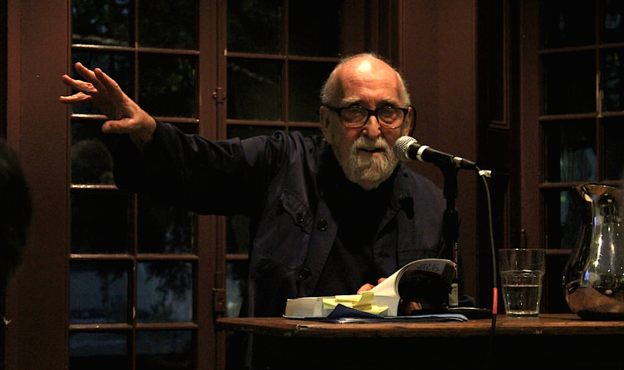
Andrew Schelling on Gary Snyder�s �This Present Moment: New Poems�


This Present Moment: New Poems
Gary Snyder
Counterpoint Press, 2015
88 pp.; $22.00 (Cloth)

A flat package arrived in the mail 15 years ago. When I opened the envelope it held a photocopy of the Candamaharoshana Tantra, both its original Sanskrit text and an English translation by the scholar Christopher S. George. A note Gary Snyder had tucked inside said, �I only give this to friends over 40, and married.�

The Candamaharoshanais a dialogue between Shiva and his wife, Parvati. Its intent is to break both attachment and revulsion toward the body through the most extreme sexual practices of devotion, cherishing the smells, the wastes, the hidden inward operations of digestion, excretion, salivation, and perspiration of the beloved�s physical body. In talking about two recent books, one by Gary Snyder, one a compilation of talks and lectures around his work, I want to keep that gift with its little note in mind, because it reveals two practices that run through Snyder�s writings. The first: it does no good to shy from the darker, more troubling aspects of life and death, the vegetative, the fermentative, the composting. These can give rise to compassion. The second is the recognition that some teachings should be held back. They are not for everybody. You keep them in reserve until the student is prepared.

The two books are notably different. A Sense of the Whole: Reading Gary Snyder�s Mountains and Rivers Without End, contains papers gathered and edited by the American scholar Mark Gonnerman. In 1997, Gonnerman organized a yearlong workshop at Stanford Universityaround Snyder�s newly released, 40-years-in-the-making long poem Mountainsand Rivers Without End. During the course of his workshop he invited poets, critics, and Buddhist scholars to meet with students and address the multiple layers of history, poetry, Buddhism, ecology, geography, and Native American studies that the poem braids together.

One thing to remember with the appearance of Gonnerman�s collection is that Gary Snyder writes poems of varying degrees of difficulty. Using the terms of white water rafting, or �river-running,� he likens much of his poetry to Class III runs, �where you will do just fine on your own.� His long poem, though, Mountains and Rivers Without End, �is more like Class V: if you�re going to make it to take-out you might need a guide.� Gonnerman�s collection is not exactly a field guide, but a kind of rucksack filled with necessary gear.

Michael McClure, Snyder�s long-time friend and fellow poet, likens Mountains and Rivers Without End to a medicine bundle. Its 39 separate poems, written �at the pace of about one a year,� could be talismans that make up that bundle. Snyder began the poem in 1956, completing and publishing it 40 years later. When as a young poet he was setting forth on what he knew would be a lengthy project, Snyder recalls, �I found myself tracking about 25 things at the same time. That meant I had to spread out over a lot of territory, going back and forth, you know, trying to pick up different traces as I went, staying on the trail.�

This is why A Sense of the Whole comes as a welcome commentary, a companion to the myths, histories, and scientific tracks that cross through Snyder�s work. You can read McClure�s thoughts, as well as insights by the poets Wendell Berry, Robert Hass, and Nanao Sakaki; by the Buddhist scholars Stephanie Kaza, Carl Bielefeldt, and others. In particular the contributors cast light on the poem�s use of East Asian landscape painting, its carefully informed encounter with the shamanic-Buddhist Noh theater of Japan, and on the geographical range of the poem. It is a poem that, Snyder observes, �I have come to think of as a sort of sutra�an extended poetic, philosophical, and mythic narrative of the female Buddha Tara.�

His latest poems�more like koans than sutras�come two decades after he finished Mountains and Rivers. The collection�s title, This Present Moment, is a phrase that seems to be something of a personal mantra for the poet. The brief poem that provides the title might blow past without much effect at first. Best to give it some space and concentration, and let it slowly work its medicine.

This present moment
that lives on
         to become
         long ago
What do I mean by calling it a personal mantra or likening it to a slow medicine? Mainly, its recurrence over the years. The poem showed up first as the final page in a collection Snyder published in 1999. It reappeared in a new context, as part of a haibun [a Japanese literary form that combines prose and haiku], in his 2004 book, Danger on Peaks. There it is the tiny haiku-like verse that caps a paragraph, set in a restaurant that had formerly been a bookshop, in which he meets an old friend, �an ex-longshore union worker� who was once married to Snyder�s sister, Anthea. The passage of time, aging, change, and the disappearance of kin and comrades hang over the haibun as they do over the new collection. So do friendship, a long view of what time is, and a poignant sense of life�s preciousness.

Now the same stanza provides the title and also serves as the final word, the last page, the ceremonial closing, to this new book. It gestures at a recurrent theme Snyder has worked over the years. All beings�mountains and rivers, rocks, trees, mammals, birds, fish, and humans�are tender things emerging in this present moment; they have also embarked on a long journey of change that seems to start before birth and continues long after death. We ourselves, however present we might seem, will become �long ago.� Maybe that�s because�as the Prajnaparamitasutras keep repeating�there are no permanent beings.

And yet . . .

The huge Mahayana cosmographies, which speak of billions upon billions of buddha realms throughout huge gulfs of time, seem too vast for our limited minds to keep in sight. Big visionary sutras can elude us or leave us coldly amazed. They don�t really convey the truths of suffering, old age, and death. For that, we need friendship and family, so that love, anger, and grief can move through us. Yet clues to the big mystery are all around, and humans can hesitantly read the marks. Waves and ripples in rock that recall prehistoric oceans; animal tracks left in the mud, dried out a million years back; fossils of ancient life forms. All of these, in their own way, point to the Buddha�s path. The 12th-century Zen master Dogen said, �Mountains and waters right now are the actualization of the ancient buddha way.� This is why traces of geological time run through Snyder�s poetry. They give glimpses we can almost comprehend of the vast journey all beings are on.

The poem �Wildfire News� opens:

For millions,
for hundreds of millions of years
there were fires. Fire after fire.
Fire raging forest or jungle,
giant lizards dashing away
big necks from the sea
looking out at the land in surprise�

How does a human contend with the stretches of time covered by these seven lines? Snyder closes the poem by staring more closely at the giant sequoia, holdovers from the age of great reptiles:

. . . they covered the continents
ten lakhs of millennia or more.
         I have to slow down my mind.
         slow down my mind
         Romewas built in a day.
The poems in this slender 88-page book range across our planet. There are pieces written in, or written about, Turtle Island (�the old-new name for North America� he called it decades ago, recharging landscape with old myth), India, Madagascar, South Korea, Paris, and Rome. That last city seems close to the origins of what most Euro-Americans think of as civilization�yet from the viewpoint of deep time, Rome was �built in a day.� Her architecture pushes back into geology. Neither her buildings, her stones, nor her layers of language will stand in place for long.

Roma

         Built back of old stones from old buildings,
         old bricks and stones on even older stones
         �always-changing languages
         broken tumbled talus slopes again

Many turn to Snyder�s poetry for teachings. Teachings on love, friendship, ecology, impermanence, politics, scholarship, Buddhist insight, child-raising. There are circles among the avant-garde too full of irony, too self-contained, often too cynical, to accept both those ancient imperatives of poetry, to delight and to instruct. They simply do not accept that poetry has the task of changing values; maybe they think it not possible. Snyder wrote in a 1977 letter to the poet and environmental activist Wendell Berry, quoted in A Sense of the Whole, �As poets, our politics mostly stand back from that flow of topical events; and the place we do our real work is in the unconscious, or myth-consciousness of the culture; a place where people decide (without knowing it) to change their values.�

The hinge poem in This Present Moment, for me, is one full of instruction. �Stories in the Night� begins as an account of Snyder at his homestead in the Sierra Nevada foothills, working on a series of generators, inverters, and solar panels, which have quit working. His house, built in the early seventies, never on the electricity grid, depends on this setup.

I try to remember machinery can always be fixed�but be ready to give up the plans that were made for the day�go back to the manual� call up friends who know more
Suddenly the poem turns�it took my breath away the first time I read it �and the meditation on power flashes to earlier days, when he used kerosene, not solar, to read by. Then earlier days rise up: �In 1962 going all through Kyushu with Joanne, walked around Hiroshima.� There he sees the �twisty shiny scarred burn-faces of survivors� from the bombs of 1945. Abruptly power has become �too much power��making ghastly and immediate the threat to all our planet�s creatures.
Over two dense pages the poem chews across history, politics, anthropology, and religion. With a wry humorous eye it glances at monotheism, with the appeal to a far-off, single source of power. Under the poem stir questions Snyder has wrangled with for decades. What do we really need for our lives? How much power is necessary? What is the source of real power? Does it come from outside or from within? He invokes �all the wriggling feelers and little fins, the spines, / the slimy necks,�eyes shiny in the night�paw prints in the snow,� that make the epic journey alongside humans. The poem then ends�imagine the poet alone, darkness coming on, his busted generator, the unlit bulbs he uses for study�

The old time people here in warm
earth lodges thirty feet across
burned pitchy pinewood slivers for
their candles,
snow after snow for all those
centuries before�
lodgefire light and pitchy slivers
burning�

         don�t need much light      for stories in 
         the night.

Much of Snyder�s poetry does this. It brings you to the present moment, which already seems long ago. Even the bright rhyme of the final two phrases��don�t need much light for stories in the night��work to place you here and at the same instant there.

One task of his poetry is to continually set human frailty against stretches of time we can scarcely imagine. The effort to imagine the now, laid across a long- ago future, is exhilarating. It blows away our self-image. �Two of my best friends quit speaking,� he writes; �one said his wrath was like that of Achilles.� In a curious, matter-of-fact tone, Snyder dignifies the troubles we humans go through, setting them into a mythic past. The heroes we�ve heard about suffered turmoil and conflict just like us.

This might be Class III poetry, the poetics of living, where little glimpses of forgiveness or breathlessness glint. From a perch atop the Eiffel Tower, Snyder looks out and sees Europe�s extinct megafauna�aurochs and mammoths probably taken down by the spears of human ancestors�browsing the tundra. It takes practice to see these extinct mammals, but you can glimpse them: if you look with the eye of poetry, the eye of scholarship, or what Dogen called the true dharma eye. These are poems for the living.

The poetry of death, though, that�s something else. Would Snyder consider poems of death to be Class V rafting experiences�poems that need guides? Or might poems of real, not speculated, death hold secret teachings, beyond the expertise of a seasoned guide? Maybe these should be given only to readers who are spiritually prepared. Up to this point the book has been a volume of vintage Snyder. If anything he has become more colloquial, increasingly compressed in his language, his visions see farther, his admirable learning sits more lightly, his Buddhist training moves in his musculature. Then comes the final poem.

Gary Snyder�s wife, the writer and eco-activist Carole Koda, died in 2006. This Present Moment ends with a funerary poem for her, �Go Now,� unlike anything I have seen in poetry, in North America or anywhere else. It is both a prayer and an unflinching physical depiction of his wife�s departure on the great journey. It opens with a tantric warning:

You don�t want to read this,
reader,
be warned, turn back
from the darkness,
go now.

We have stepped near the realm of the Candamaharoshana Tantra. The poem is about to enter the place where love will be challenged by bodily fluids, the stench of decay; courage will be challenged by shrinkage and fear. To read it you may indeed need to be over 40, and married. The lessons have little to do with what you get out of books or inspirational lectures on Buddhism.

�about death and the
death of a lover�it�s not some vague meditation
or a homily, not irony,
no god or enlightenment or
acceptance�or struggle�with the
end of our life

Zen and tantra both use injunction to goad you toward practice. �Don�t read all those books,� Zen scowls, then amasses huge libraries. Turn back from the darkness, warns tantra. If you go in, carry strong medicine. The pages of �Go Now� may work as a medicine�bitter but fortifying. Ordinarily when a poem with unique medicinal power appears I urge companions to go out and read it. With this poem I�ve been cautious. Years ago Snyder wrote a lyric in which his poetry comrade Lew Welch appeared from the dead; when Snyder noted the tingling down his back, Welch replied, �There�s a basic fear between your world and mine. I don�t know why.�

While I was reading This Present Moment a second time through, word came that my ex-wife had died out in California. Suddenly everything else I was working at paled. The task was to go there, accompany our daughter to formally identify her remains, do a ceremony over the body, and send her on for cremation.
One purpose of poetry�its archaic, struggling simplicity still makes it the strongest of the arts�is to point a way forward. Not forward in a prophetic sense; simply that those who have walked the trail already show how things can be properly done. In old Indiathey believed that poetry regulates the emotions and helps order society. All those surging, chaotic passions that swirl through, when you stand by the empty husk of someone once loved, have a settled place. They are, in Snyder�s economical words, the �price of attachment.�

being there,
seeing and smelling and feeling it,
thinking farewell

You lay a few flowers on the frightfully rigid breast; read a poem that both the living and the dead can hear; ring a bell if you�ve brought one into the crematorium. Then comfort the children as best you can. And walk back out onto the planet. It was worth it.

�Easily worth it�.� 

[Published originally in Tricyle, a magazine & online site described elsewhere as �the leading independent journal of Buddhism in the West.�]

Andrew Schelling is a poet, wilderness explorer, and translator. He teaches writing and Sanskrit at Naropa University. Among his 20 books is the recent Love and the Turning Seasons: India�s Poetry of Spiritual and Erotic Longing.

Monday, 7 December 2015

Nakahara Chuya: Six Poems Newly Englished, plus a single Transcreation

Translations from Japanese by Jerome Rothenberg & Yasuhiro Yotsumoto

note. Over a short lifetime, Nakahara Chuya (1907-1937) was a major innovator along lines originally shaped by Dada and other, earlier forms of European, largely French, experimental poetry. In 1997, as part of an annual poetry festival in his home prefecture of Yamaguchi, I came to his grave along with a group of Japanese poet-companions, to celebrate the 60th year of his death and the 90th of his birth. The poem marking that time, �At the Grave of Nakahara Chuya,� appeared a few years later in A Paradise of Poets and included a fake �translation� (a �transcreation� perhaps, as Harold de Campos might have had it) in what I took to be his style, or one of them, that brought some of his work into the domain of popular Japanese music. The six poems presented below are the latest results from a more recent attempt at actual translation, but a part of my earlier poem-song can also appear here as a further homage:

As sportscoats are to toothpaste
as the boa is to scales
as black teeth are to playful ghosts
as seasons are to smiles

As telephones are to toasters
as angels are to air
as wagon wheels are to ups & downs
as horses are to fire

As Buddha is to Buddha
as a toenail is to glass
as the way we make love is tight like that
as ascensions are to cash

As harbors are to hairpins
as napoleons are to joy
as bicycles are to icicles
bones are to a dada boy

(J.R.)

�a bone�

Look at this, it�s my bone,
a tip of bone torn from its flesh,
filthy, filled up with woes,
it�s the days of our lives
sticking out, a blunt bone
bleached by the rain.

There�s no shine to it,
innocent, stupidly white, 
absorbing the rain,
blown back by the wind,
just barely
reflecting the sky.

Funny imagining, seeing
this bone on a chair
in a restaurant
packed to the gills, & eating
mitsuba leafy & boiled,
a bone but alive.

Look at this, it�s my bone,
& is that me staring
& wondering: Strange,
was my soul left behind
& has it come back
where its bone is,
daring to look?

On the half dead grass
on the bank of a brook
in my home town, standing
& looking � who�s there?
Is it me?  A bone
sticking out
a bone stupidly white
& high as a billboard.

poem: sad morning

sound of a brook
comes down
the mountain:
spring light
like a stone:
the water running
from a spout
split open:
more a grey-haired
crone, her story
pouring out.

mica mouth
I sing through:
falling backward
singing:
drying up
my heart
lies wrinkled:
tightrope walker
in between
old stones.

o unknown fire
bursting in air!

o rain of echoes
wet & crowned!

��������.......

clap my hands clapping
this way & that

poem: evening with sunlight

hills retreat from me
arms crossed over chest
& sunsets colored golden
mercy colored

grasses in fields
sing oldtime songs
on mountains    trees
old hearts remote & still

here in this time & place
I�ve been   meat of a clam
a babe�s foot stamps on

here in this time & place
surrender     stubborn    intimate
arms crossed walking off

poem: an evening in spring

the tin roof eats the rice crackers
spring now the evening�s at peace
ashes thrown underhand soon turning  pale
spring now the evening�s at rest

ah! it�s a scarecrow � is it or is it?
& a  horse neighing? � nothing I hear
only the moon shining slimes itself up
& an evening in spring limps behind

a temple out in a field dripping red
& the wheels on my cart lose their grease
the historical present was all I know
the sky & mountains mock me & mock me

a tile has just peeled loose from the roof
now & forever it�s spring
the evening is moving forward & wordless
where it finds its way into a vein

autumn poem

1.
The field until yesterday
was burning   now
it stretches under clouds
& sky   unmindful.
And they say the rain
each time it comes
brings sutumn that much
closer   even more so
autumn borne cicadas
sing out everywhere,
nesting sometimes in a tree
awash in grass.

I smoke a cigarette,
smoke spiraling
through stale air,
I try & try
to stare
at the horizon.
Can�t be done,
The ghosts of heat
& haze
stand up or flop down.
And I find myself alone there,
squatting.

A cloudy sky
dark golden light
plays off    now
as it always was,
so high I can�t help
looking down.
I tell you that I live
resigned to ennui,
drawing from my cigarette
three different tastes.
Death may no longer be
so far away.

2

�He did, he said so long & then
he walked away, he walked out from that door,
the weird smile that he wore, shiny like brass,
his smile that didn�t look like someone living.

His eyes like water in a pond the color when it clears,
or something. He talked like someone somewhere else.
Would cut his speech up into little pieces.
He used to think of little things that didn�t matter.�

�Yes, just like that.  I wonder if he knew that he was dying.
He would laugh and tell you that the stars became him
when he stared at them. And that was just a while ago.
���������
A while ago.  Swore that the clogs that he was wearing 
     weren�t his.�

3

The grass was absolutely still,
and over it a butterfly was flying.
He took it all in from the veranda,
stood there dressed in his yukata.
And I, you know, would watch him
from this angle.  Staring after it,
that yellow butterfly.  I can remember now
the whistles of the tofu vendors
back and forth, the telephone pole
clear against the evening sky.
Then he turned back to me and said �I ...
yesterday, I flipped a stone over that weighed
maybe a hundred pounds.� And so I asked
�how come? and where was that?�
Then you know what?  He kept on staring at me,
straight into my eyes, like he was getting mad,
or something � That�s when I got scared.

How strange we are before we die �

prose poem: never to return
                              Kyoto

World�s end, the sunlight that fell down to earth was warm, a warm wind blowing through the flowers.

On a wooden bridge, the dust that morning silent, a mailbox red & shining all day long, a solitary baby carriage on the street, a lonely pinwheel.

No one around who lived there, not a soul, no children playing there, & I with no one near or dear to me, no obligation but to watch the color of the sky above a weathervane. 

Not that I was bored.  The taste of honey in the air, nothing substantial but enough to eat & live from.

I was smoking cigarettes, but only to enjoy their fragrance.  And weirdly I could only smoke them out of doors.

For now my worldly goods consisted of a single towel.  I didn�t own a pillow, much less a futon mattress.  True I still had a tooth brush, but the only book I owned had nothing but blank pages.  Still I enjoyed the heft of it when I would hold it in my hands from time to time.

Women were lovely objects but not once did I try to go with one.  It was enough to dream about them.

Something unspeakable would urge me on, & then my heart, although my life was purposeless, started pounding with a kind of hope.

*

In the woods was a very strange park, where women, children & men would stroll by smiling wildly.  They spoke a language I didn�t understand & showed emotions I couldn�t unravel.

Looking up at the sky, I saw a spider web, silver & shining.

Monday, 30 November 2015

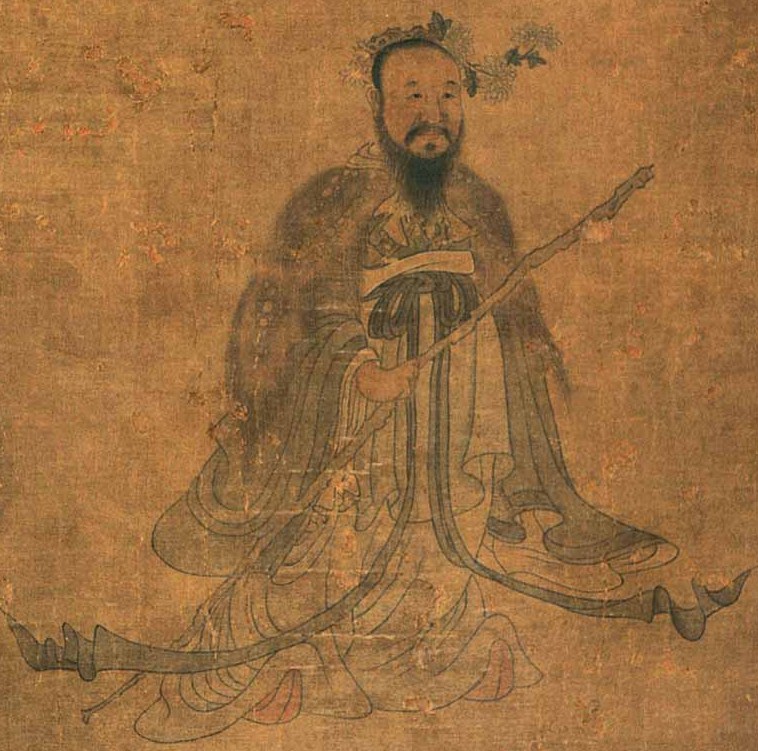
Wai-limYip: From �The Nine Songs,� An Ancient Ritualistic Drama (by Qu Yuan [Ch�u Yuan])

 Portrait of Qu Yuan by Chen Hongshou
[This excerpt from The Nine Songs by Qu Yuan (332-296 B.C.), which appeared in the earlier edition of my Technicians of the Sacred in Arthur Waley�s different & text-only translation, was in its origins a clear example of poetry as an act of �total performance.�  Writes Wai-lim Yip as translator: �Recent scholarship, particularly the work of the poet-scholar Wen Yiduo, sees Qu Yuan's The Nine Songs as a collection of songs of folk and oral nature used in ancient shamanistic ritualistic dramas performed near Dongting Lake in Hu�nan Province. The songs as they appear in the Chu Cior The Songs of the South(consisting of one single, ambiguous voice and in the form of poems) are believed to have been greatly worked over by Qu Yuan. Wen Yiduo, himself a famous modern Chinese poet of the 1920's, in addition to his many essays tracing the poem to relevant origins, reconstructs The Nine Songs into a performable structure. The present translation is a slightly modified version based on his reconstruction.� 
What follows is how the excerpt will appear in the expanded edition of Technicians of the Sacred now in progress. (J.R.)]

The Senior Arbiter of Fate

(Upon the Kongsang Mountain, a stretch of dark clouds.  Half-visible among the clouds, a huge black gate of the North Palace.  At the bend of the mountain is parked a jade-chariot driven by four dark horses.  Some beautiful girls are playing.  Suddenly, a trumpet is heard, and the Arbiter is seen walking toward the gate.)

          Arbiter:  May the gates of Heaven be opened wide!
                         I ride upon a dark cloud
                         And command the whirlwind to be my 
                              herald.
                         May the chill rain lay the dust to rest!

(The Arbiter sees the beautiful girls, descends quickly and runs after them. Surprised, the girls try to escape. The Arbiter succeeds in catching one of them.)

          Girl :        The Lord circles and circles in the sky and 
                                 suddenly descends.
                           Would that I follow you to the Kongsang 
                                 Mountain!
                            Variegated and manifold are the peoples 
                                 in the nine provinces
                            Whose lives and deaths are in your hands.

(The Arbiter and Girl  begin to dance.  The other girls now come back to cheer them on.)

          Girl :          Skyward flight, how smooth and serene!
                             He rides upon the pure air, commanding 
                                  yin and yang  .
                             Quickly, solemnly, I hasten to follow you, 
                                  my Lord,
                             To accompany you all the way to the Nine 
                                  Mountains.
                             Cloud-robes flutter and flutter.
                             Jade-pendants quiver and quiver.

          Arbiter:  One yin and one yang, one yang and one 
                                   yin.
                         None knows the extent of my power.

          All in chorus: One yin and one yang, one yang and 
                                        one yin.
                                  None knows the extent of my power.

(The girls are all exhausted and fall asleep on the ground. The Arbiter is left alone, as if in deep contemplation.  Picking a flower from the bush and quietly putting it into the Girl's palm .)

          Arbiter: I pick this rarest cassia flower
                        For the one who lives away from home.
(The Arbiter sighs.)                  
                        Old age has now crept in, closing upon me.
                        Not to come closer ends in drifting apart.

(The Arbiter quietly goes.  Girl wakes up, finds the flower in her palm, looks for the Arbiter and catches sight of the Arbiter leaving up in the clouds, to her great dismay.)

          Girl:        He rides upon the rumbling dragon-chariot
                            Soaring, soaring into the high heavens.
                            Twisting the cassia-branch, I wait.
                            Longing, O Longing cuts deep into my 
                                 heart!

          Chorus:    Sorrow, sorrow cuts heart; to it, what can 
                                 we do?
                            How one wish the now is forever.
                            Man's course is fated.
                            Unions and separations, who can master 
                                 them?


The Lesser Arbiter of Fate

(Sunset. In a garden full of semi-tropical flowers. Several girls are playing in the garden. The Lesser Arbiter of Fate arrives.)

          Arbiter:  Autumn orchids and deer parsleys
                          Grow in rows and rows under the hall.
                          Green leaves, white flowers
                          Such fragrance! to attack my senses.

          Girl :       It is nature's law that man finds 
                               his woman.
                          No need to be so down, so sad.

          Arbiter:  Green leaves, white flowers
                          Such fragrance! to attack my senses.

          Girl :       Autumn orchids are green upon green.
                          Green leaves, in sprays, emerge from 
                               purple stems.
                          A full hall of beautiful girls;
                          Why me, why his eyes are all glued at me, 
                               ever so suddenly?
                          Ever so suddenly?

(For some unknown reasons, the Arbiter, apparently agitated, leaves in a hurry.)
              
          Girl :       Coming: no words. Leaving: no words.
                          He rode away upon the winds, carrying 
                               flags of cloud.
                          Grief, not to grieve? O this life-separation!
                          Joy, not to enjoy? O friends that we newly 
                               made!

          Chorus:   Joy, not to enjoy? O friends that we newly 
                                 made!
                          Grief, not to grieve?  O this life-separation!

          Girl :       Lotus-garment, basil-belt;
                          So sudden, he came, so sudden, he went.
                          In the evening, he rests in the precincts of 
                               God.
                          Lord, whom are you waiting for by the 
                               clouds' edge?

          Arbiter (from afar):
                          I would bathe with you in the Pool of 
                               Heaven
                          And dry your hair in the Bank of Sunlight.
                          I look for the Beautiful One who has not 
                               come.
                          Loudly into the winds, I sing my song.

          Chorus:  Peacock canopy and kingfisher banners,
                          He mounts the Nine Heavens, stroking the 
                               comet,
                          Stroking his long sword  to protect the 
                               young and the old.
                          O You alone, the most fit to judge over 
                                men.

                           
The River God

(The River God emerges from the water riding on the back of a white turtle. Fishes of all imaginable kinds swim around him. The River God sings in response to some girls dressed in white in front of the riverside temple.)

          God:   With you I will roam the nine rivers.
                      A riot of winds arises and cuts across the 
                           waves.
                      We will ride the lotus-canopied water-chariot
                       Drawn by two dragons flanked by hornless 
                            serpents.

          Girl:     I climb up the Kunlun Mountainsand look in 
                            all directions.
                       My spirit flies high as I face the infinite 
                             space.
                       Dusk is here; absorbed, I forget to return.
                       I only look back upon the distant shore.
                       A fish-scale house, a hall of dragons,
                       A purple-shell gateway and a palace of pearl,
                       O God, why do you dwell in the waters?   

          God (ignoring her question):
                       Riding a white turtle, chasing spotted fishes,
                       I will roam with you among the small islets
                       As swollen waters come tumbling down.
                       With crossed hands, I will go with you to the 
                            East,
                       To escort my beautiful one to the Southern 
                            Shore.
                                                                                 
                                                                                                you.
   God & Girl:  Wave after wave comes to welcome
                                                                                                 me.

                        Shoal on shoal the fishes take us all the way.

Monday, 23 November 2015

Translation without Limits & the Limits of Translation, Part Two: �The Joys of Influence�


Keynote speech, American Literary Translators Association annual meeting, October 30, 2015, continued from posting on November 16 here& here.

I realize that where I am at this point is already at a considerable distance from what my more literally directed side (and yours) would recognize as translation, that it begins to touch on what I have elsewhere and persistently spoken of as �othering� (a word my spell-check refuses to recognize as legitimate).  Still I would like to digress for a few minutes to speak of collaboration as it touches on translation and as a foundational part of my poetics and an antidote perhaps to those anxieties of influence that were injected into literary discourse some forty and more years ago.  Translation of course is, at its best, the joyful acceptance of influence and of shared voices in the process of creation and transcreation.  In that sense too it opens to an acceptance of collaboration and community (however problematic they may sometimes be) as foundations for the work at hand.  And I would take translation as a metaphor for the entire poetic process.
            My over-all experience of collaboration goes well beyond translation � work with artists & musicians. with editors and book designers, with performance troupes like The Living Theater, with poetry readings and publications shared or organized in common � all of which I came to see (rightly or wrongly) as a principal mark of the avant-garde in poetry & art.  This idea of an avant-garde, at least as I conceived it, is � or was � the work of individuals acting together � an effort somehow in common, even if performed one by one.  There are times of course when an individual proclaims himself to be an avant-garde, but I don't believe that there are, strictly speaking, avant-gardes of one.  (There are great & unique experimentalists who operate in isolation, but that I think is something different � referential sometimes to an avant-garde but different.)  And there are individuals also � Bretons or Marinettis � who dominate their avant-gardes, probably to nobody's advantage.   Strong individuals like that, I now believe, were not only influential in forging their avant-gardes but were responsible as well for the ephemeral nature of what they had created.   In that sense it�s also possible that avant-gardes are destined for short lives, hellbound for self-destruction � or an aspect, maybe, of what Tristan Tzara might have had in mind when he told us that �the true Dadas are against Dada.�  (Cooptation by the art market is of course another factor to consider.)
            In addition I thought of the big books, which were as often as not co-authored with one or two other poets or editors, not so much as anthologies but as assemblages or collages that fulfilled for me the primary function of collage � to bring the words of others into the work at hand.  It was the recognition of something like that, I think, that freed my own poetry to be more than it had been to start with.  It also energized me in the direction of translation � an activity that I�ve pursued into the present.  Even working as a solitary translator I felt myself in an interaction with whoever I was then translating, and I came to believe that all translation � of poetry at least � was inherently a matter of collaboration.  (I�ve called such processes � both of translation and collage � �othering� and have spoken about them elsewhere.)  But to carry on the translation work in particular, I often had to call on the help of others � either because the task at hand was too big or too foreign or needed more than my own voice to make it stick.  
With the ethnopoetic books I thought that all of this was obvious.  Technicians and Shaking the Pumpkin were assemblages of (mostly) translations, generally as I found them but sometimes with interventions of my own.  The range of languages was vast, & my own competence outside of the European sphere was non-existent.  On two principal occasions I came more properly into the translator�s role � both times with a collaborator.  In the one instance (Seneca Indian) my co-worker was a native speaker & songmaker, Richard Johnny John, and in the other (Navajo) the work was made possible by the great American ethnomusicologist David McAllester.  Aside from that � and apart from the ethnopoetic experiments � there were Hebrew translations with Harris Lenowitz for A Big Jewish Book and a more recent book of poems from the Czech modernist poet Vitezslav Nezval (Milos Sovak my co-translator there), in addition to which the ample books of poetry from Schwitters and Picasso were assembled alongside Pierre Joris (and in the case of Picasso a number of other poet- translators whom we brought together for the project).
It is in this context, then, that I would speak of translation with a recognition that my own work, as well as that of others, is not only experimental or avant-garde but practices all those forms of translation that John Dryden spelled out centuries ago: metaphrase, paraphrase and imitation, three procedures with varying degrees of departure from the original.  Or put another way, I�m mindful of the observation somewhere attributed to Wallace Stevens that �all translation is experimental translation.�  To which I would add that all translation [at least of poetry] is collaborativetranslation ... from the perspective at least of the poet translator.  As such my own experience has been that when I�m most intensely into the act of translating, setting another before me � �the most sublime act� as Blake would have had it � I am or I feel like an actor immersed in a role, becoming that role or character,  or like a dancer, say, responding to the movements of a partner, then thrown forward to do the dancing on my own.  The Lorca Variations, from which I read earlier, are the clearest example I have of this � from translations in immediate response to Lorca (developing my own rhythms as I go, but always with Lorca to guide me) to poems of �my own� which retain words from my translation but leave me free to compose anew.

With  that in mind I want to end with a twofold exploration of myself not as translator but as the object of translation and variation. 

A few years back, while I was preparing (with the Mexican poet Heriberto Y�pez) a large anthology-like assemblage of my own writings, Eye of Witness: A Jerome Rothenberg Reader, the retrospective nature of that work opened me to the idea of applying to earlier poems of my own the procedures I had followed for Lorca and others in the �variations.�  That meant, as with the other variations, taking a poem of some length, isolating mostly the nouns and some adjectives, rearranging the order in which they appeared, and using them as what Jackson MacLow called �nuclei� in the seeding or composition of new poems.   I was also mindful of two statements attributed to Henri Matisse when he was my age or possibly a little younger: �One should be able to rework an old work at least once � to make sure that one has not fallen victim � to one�s nerves or to fate.� And again: �When you have achieved what you want in a certain area, when     you have exploited the possibilities that lie in one direction, you must, when the time comes, change course, search for something new.�

[Reads: Jigoku Zoshi & variation]

The final experience of translation, however, came on the various occasions when my work was being translated into another language, but particularly where I was familiar with that language and, even more so, where I was able to work along with the translator.  That process in several instances was truly exhilarating while it also brought me up against the limits of translation and the strategies of the translator in trying to address them.  Some of this is obvious to all of us here and applies in whatever direction the translation is going: how to distinguish heaven from sky in most European languages, or spirit from mind in others.  For the former too I ran into a problem compounded by an element of word play, when I included a short sentence � �I will change your mind� � in a series of manifesto propositions, for which the translation could never be handled properly.  Or there is another instance where I speak of mind changing into spirit or of spirit changing into mind, and another example in a line and a poem title �the sky that harbors heaven.�
            Those of course are familiar instances, but the translation problem has been compounded for me in a recent series of poems (�Divagations�) where rhyming enters the picture.  I don�t here mean structural or end rhyme, where the rhyming words don�t have to be consistent between the original and the translation.  Rather what I�ll present to you now is from a series of poems called Divagations, which are currently being translated for a new book in French.  The rhymes here are obvious and have a relevance both to sound and sense.

[Reads and discusses: Divagations (1)]

An even clearer instance is a poem from a series that drew on images from Goya�s masterwork Caprichos and were then translated into Spanish by Mexican poet Heriberto Y�pez.  What the Goya image gave me were two animal figures, a monkey and a donkey in English, but most literally �un mono� and �un burro� in Spanish.  My poem however took the rhyming coincidence in English as a point of departure to seed the entire poem with rhymings.

[Reads: �A Monkey & a Donkey�]

In this instance anyway, since Y�pez and I were very close, we worked on several of the rhymes together, and at a couple of points we rewrote lines in question, to get the same effect if not the same meaning in Spanish.  It strikes me that more was possible here � a greater degree of Dryden�s �imitation� or de Campos�s �transcreation� or my own �othering� � but maybe we�ll get back to that in the years ahead.

[Reads: �Un asno y un chango�]

I will close then � if the time allows � with a translation of my work that I was most able to incorporate into the performance of my own poetry once it came into my possession.  The poem in question was the opening of Poland/1931, my attempt in the 1970s to create an ancestral poetry of my own �in a world of Jewish mystics, thieves and madmen.�  Amos Schauss, a translator whom I had met briefly and who was a rabbi and teacher at Hebrew Union Collegein Cincinnati, worked up a translation of the poem into Yiddish � possibly with my assistance, possibly not.  What resulted, from my perspective, was a perfect match for the English and allowed me the pleasure, in performance, to top off the range of Jewish works I was pursuing at that time � what David Meltzer called my �yiddish surrealist vaudeville.�  For this I remain grateful to Schauss for a gift of translation beyond any that I ever had, either then or later.

[Reads: �The Wedding� in English and Yiddish]